From the "Spokesman Review."
July 23, 1947


This site features daily historical railroad posts from the Big Bend/Columbia Plateau region of Washington state. As a personal site, this is my online filing cabinet of interesting things I've come across about railroading in the area. Thanks for stopping by!
From the "Spokesman Review."
July 23, 1947
Each square represents a square mile. Section 21 is where the water tunnel for the Federal irrigation project comes out, near where the siding of Connolly was established in section 22. Connolly was named for the contractor that was building the tunnel in a few years. The double dotted line meandering in section 34 is the original alignment of Pinto Ridge Road.

From the Spokane "Chronicle."
October 14, 1946
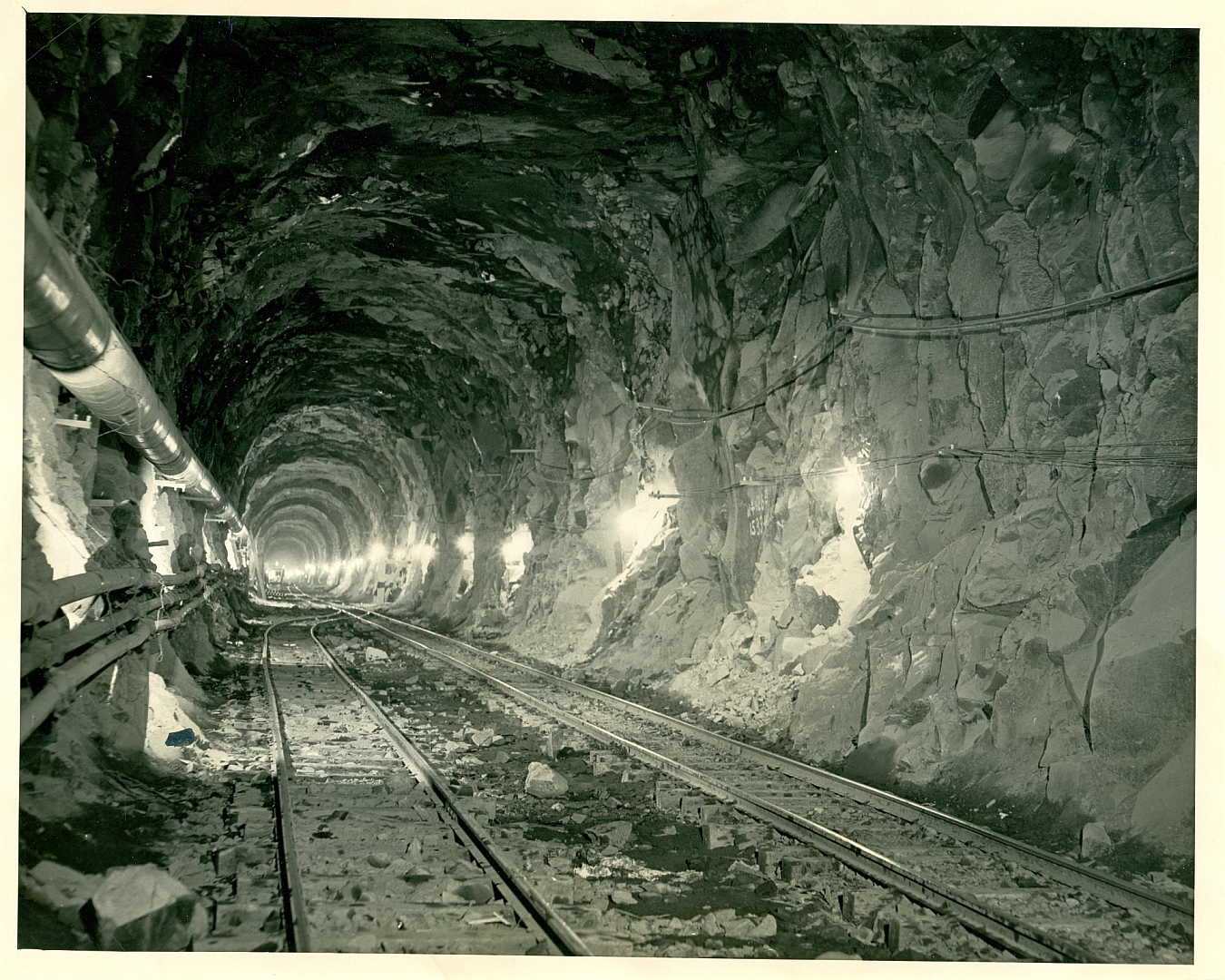
There was a short construction railroad out here that helped haul muck out of the tunnel.


Columbia Basin Project The Columbia Basin Project (CBP) is the largest Reclamation project in Washington. At 670,000 acres under irrigation today, the CBP is still unfinished as it is planned to irrigate over 1,095,000 acres in the project area (U.S. Department of the Interior, Bureau of Reclamation, 2004, p. 44; Warne, 1973, p. 127). The project area is in Adams, Douglas, Franklin, Lincoln Grant, and Walla Walla Counties. It turned dry-farmed lands and sagebrush into one of the most productive agricultural areas in Washington. This project was also to spur settlement of new farms for veterans returning from World War II.
After World War II the boom experienced in the development of the CBP was highest from 1952-1959 with about 50,000 acres of land a year coming into irrigation, which was the largest growth to date in the planned 1 million acres (Warne, 1973, p. 138). Water is pumped up from behind Grand Coulee Dam and impounded in Banks Lake behind Dry Falls Dam then makes its way down through the system in a series of six main canals and three reservoirs to reach all of the irrigable acreage in the Columbia Basin. This system alone consists of over 300 miles of main canals, approximately 2,000 miles of laterals, and 3,500 miles of drains and wasteways. See http://www.usbr.gov/projects/ and Columbia Basin Project History for more information about the Columbia Basin Project. Main Canal:
The CBP Main Canal begins at South Coulee Dam (today called Dry Falls Dam) and travels approximately 21 miles via canals, falls [or through a hydro-electric powerplant], a tunnel , a siphon and a reservoir to the at the bifurcation works north of Adco where the Main Canal splits into the West and East Low Canals. The CBP Main Canal was built from 1946-1951 with construction done in three sections with each section following the completed one (Simmonds, 1998, p. 39-40). While it is like many other Reclamation canals in its construction its size is what separates it from other main canals. Bacon Tunnel: One of those large engineered structures in the CBP Main Canal is the Bacon Tunnel.
Bacon Tunnel was built under Reclamation Specification No. 1236, Schedule No. 2 – Bacon Tunnel and Bacon Siphon, Main Canal, Station 92+75.5 to Station 214. The winning bidder for Schedule No. 2 was T. E. Connolly, Inc. of San Francisco, California with the amount of $3,494,470.00. The contract No. I2r-16311 involved building the Bacon Siphon Inlet Transition, Bacon Siphon, Bacon Tunnel Access House and Transition, Bacon Tunnel, Bacon Tunnel Outlet Closed Transition, Bacon Tunnel Outlet Portal Open Transition and approximately 962 feet of unlined canal between Station No. 204+38 to 214+00. These structures were built approximately 1 and 1/3 miles south of Coulee City (U.S. Department of the Interior, Bureau of Reclamation, 1948, p. 76; U.S. Department of the Interior, Bureau of Reclamation, 1950, p. xiii; Thomas, 1950, p. 1).
Construction of an access road to the outlet portal location was started on July 26, 1946 and by August the contractor’s construction camp was also started. It is interesting to note that this was before the official notice to proceed was issued on September 16, 1946 by Reclamation. The construction camp was built near the outlet portal and consisted of a mess hall capable of feeding 150 men at a time, an office building, a heating and furnace room, a wash and change house, eight army type barracks, and 20 army hutments that had been leased from Reclamation. The two access roads, one for the outlet and one for the inlet and Bacon Siphon, were both gravel surfaced. A shop area was also constructed at the outlet portal which consisted of a combination battery shop and compressor building in a Quonset Hut, a blacksmith shop, a carpenter shop, a Quonset machine shop, a pumphouse, fenced transformer rack, a large power magazine ½ mile from the camp and portal, and a smaller powder magazine for storage of blasting caps. Water was obtained from a spring and well which was pumped to an above ground 5,000 gallon tank that then distributed water via underground lines to the camp, shops and tunnel. A Quonset Hut warehouse was built on the hill above the camp next to a spur track of the Northern Pacific Railway (Thomas, 1950, pp. 4, 5 & 8).
While the construction camp was built at the outlet portal a similar shop complex was built at the inlet portal. It consisted of a building with a blacksmith and machine shop inside, a battery charging transfer and electrical shop, a washroom and change house, garage with shop, carpenter shop, three hutments for storage, a truck greasing rack, oil house, and a gas tank with a pump. In order to transfer batched aggregate from trucks a ramp was built to transfer the material to batch cars also in this location. Also located near the siphon location was a framing shed with platform and compressor house located 300 feet east in the bottom of Bacon Coulee. Additionally, two portable powder and primer preparation magazines were built along with a large powder magazine 1,200 feet west of the inlet portal. In 1947 water for the tunnel inlet and Bacon Siphon was obtained from a well that was then pumped to two tanks on the bench above the shops and tunnel to be distributed via underground lines to the shops, tunnel and siphon as required. Electric power to both inlet and outlet locations was supplied by the Grant County Public Utility District via newly constructed electrical lines. Reclamation had also two hutments moved to the jobsite for offices used for the Reclamation construction inspectors (Thomas, 1950, pp. 4 & 5).
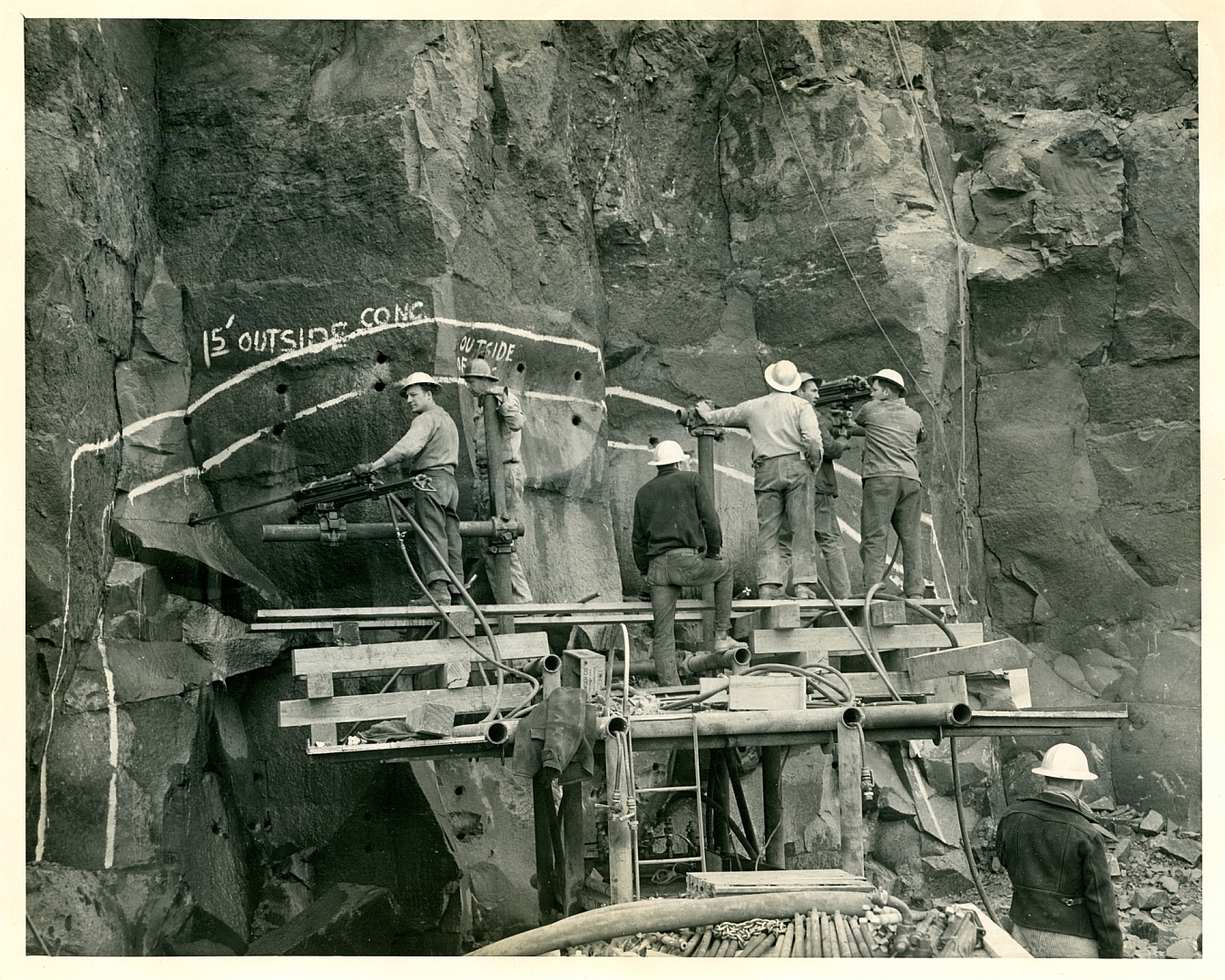
Work on Bacon Tunnel started on December 12, 1946 and it was completed by April 19, 1950. The tunnel was drilled though a 27 foot thick sandstone layer along with a basalt layer above and below it. This project was hampered by strikes in 1947, 1948, and 1950 and on January 22, 1947 a large section of basalt columns above the outlet fell at 6:20pm. Thankfully nobody was under the portal at that time as the heading crews had already gone into the tunnel just before these rocks fell. The excavation of the tunnel was started first at the outlet portal. Then on April 9, 1947 the inlet portal was started with drills and dynamite and by August 18, 1948 the tunnel was holed through. Excavation of the tunnel was done with five Conway mucking machines and the material was hauled away on a narrow gauge railway in 13 Koppel side dump cars powered by six locomotives. The Bacon Tunnel was lined with concrete and the first concrete was placed in the transition sections at the outlet portal on September 7, 1948 (Thomas, 1950, pp. 2, 6, 10, 14 & 21-22).
Concrete in the tunnel was placed in sidewall and arch lining forms which “were raised or lowered by means of 30-ton hydraulic jacks set within the vertical support frames, or legs of the form carriages” (Thomas, 1950, p. 30). The tunnel was also grouted along its route starting at the outlet portal on September 12, 1949. Concrete placement was done in sections and all of the concrete work was completed by April 6, 1950 with grouting done seven days later. April 6, 1950 was also the date the access house and inlet portal transition to the Bacon Siphon was completed (Thomas, 1950, pp. 12-13, 35, 39). THE Bacon Tunnel was considered as finished on ___
Courtesy of the Bureau of Reclamation.
November 19, 1976.
One of the last official photographs taken at the south end of the Bacon Tunnel. Seen here is one portal from the 1947 tunnel. Shortly after this photo was taken, construction on a second 2 mile long tunnel would be undertaken. The new tunnel would be built to the right of the old one in this view, and would obliterate any remaining signs of the construction railroad that was used in conjunction of the first tunnel. The NP Adrian Cutoff, seen curving through the scene here, would be abandoned by 1979, with activity at the old construction siding of Connolly being the last activity the branch had seen after 1953.