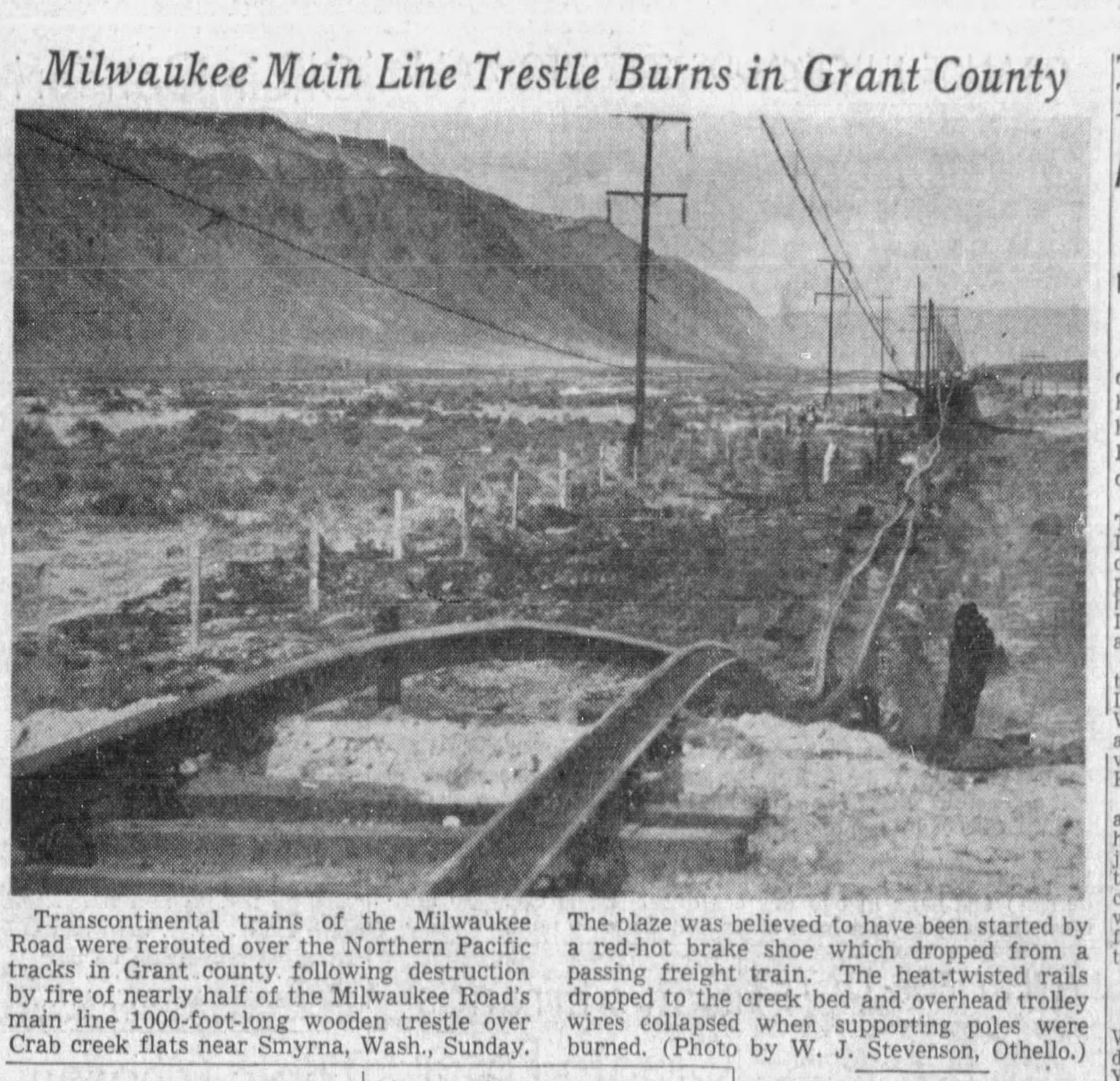
USBR photo. Courtesy of the Grant County Historical Society Museum.
May 5, 1950


This site features daily historical railroad posts from the Big Bend/Columbia Plateau region of Washington state. As a personal site, this is my online filing cabinet of interesting things I've come across about railroading in the area. Thanks for stopping by!
Courtesy of Gladys Para
From the Royal City "Capsule."
August 15 and 22, 1963


February 8, 2024.
Here's another rare moment of timely news! Hi Steve!
Courtesy of Marilyn Hedges and the Friends of the Palouse to Cascades Trail Facebook page:
There has been good progress on replacing the two Lower Crab Creek bridges that were destroyed by fire just east of Beverly and the Columbia River. Progress on the eastern most bridge is further along. The western bridge will involve a single span across Crab Creek. These are expected to be completed this Spring.


Courtesy of Dave Morgan. Photos by Eric Morgan.
SRGX 208, Speno Rail Grinder. A rail grinder working a couple of miles east of Smyrna, headed east. Exact date is not known, but I think around 1965. Photo by Eric Morgan.


Guest post by Allen Miller.
After working my first two nights as an operator at Kittitas, I then drove to Beverly to serve as night operator there. I was assigned to the Kittitas-Beverly-Cle Elum relief job, but operator Ted Pope, who had been assigned the third trick operator job at Beverly, traded positions with me, because he wanted to claim the mileage and deadhead that came with that position. This was fine by me, as I had just hired out, had limited funds, and wouldn't see my first pay check for about a month.
Arriving at Beverly I found the yard full of empty Battleships (beet hoppers) and discovered where the cars were coming from used to load sugar beets at Kittitas. On the platform in front of the depot, I saw my first Rattlesnake, a dead one, killed by the section crew earlier that morning. I also met Division Superintendent Maurey T. Sevedge, who was here in connection with the derailment at Doris last night. Beverly was kind of a legendary place with a storied past. A branch line had been built down the west bank of the Columbia River in 1913 and when irrigation was introduced to the area a fruit business erupted. Each fall the sleepy little branch came alive with carloads of fruit being shipped. Peaches the size of grapefruit were widely reported. Then, with the outbreak of World War II the towns of Hanford and White Bluffs were given notice to evacuate the area in 1943 and the government built a large nuclear reservation where the atomic bombs used to end the war were developed. 15 clerks had been added to the depot office staff to process the paperwork and billing for the many, many carloads of material brought into the area. An addition was built onto the east end of the depot to make office space for all of the additional clerks. Later, this addition was converted to a bunkhouse for the Hanford Local, who would come out of Othello on Monday, tie up at Beverly the rest of the week and return to Othello for the weekend.
But now Beverly was only a shell of what she had been in her heyday. There was no helper crew anymore, displaced by mid-train Locotrol slave units, the Hanford Local ran out of Othello as needed and returned, thus the bunkhouse annex was unused, and only a section crew under foreman Clarence Rasmusson and a night train order operator remained at Beverly.
My first night was Friday, September 3rd, 1971. Nothing much happened that first night, but there was some excitement going on at Kittitas. I was listening to the dispatcher's phone when the operator at Kitty came on and announced train 262 stopped there. Train 262 was hot enough that stopping him meant answering questions to the "DS" and so he explained that he had used the wrong hoops to hand up 262's orders and they were too long and the train had snapped them off and the crew were looking in the grass for their train orders in the dark. I had noticed those hoops on my two previous days at Kitty. They had handles that were very noticeably longer than the other hoops, making them about 6 feet high overall. I had figured them for hooping by hand to the electrics. They were positioned in the back of the hoop holder on the wall, so he would have had to remove the hoops in front in order to get them, I guess the longer handles didn't spark his curiosity, or maybe he thought all of the others were broken and that's why they were shorter. He didn't notice that once they were in the delivery rack they stuck out almost to the center of the track. I heard later that the crew almost took the top one through the windshield!
I learned my own train order hooping lesson a couple of weeks later. I had orders for two trains that were meeting at Beverly. In an effort to not delay either of them I decided to hoop up their orders by standing between them. I took a position between the main line and the passing siding and it seemed like a good idea at the start. Once the trains had me hemmed in I could see all kinds of things wrong with my plan. To start with, I had four hoops that I had to keep track of so that each train got their intended orders, once I had handed up to the head ends it was much simpler to keep track of the two remaining hoops. Once the train taking the siding had cleared, the main line train started picking up speed. The opposing motion of the trains started making me feel dizzy. I was also busy keeping an eye out for metal bands and any other objects that might be protruding from the cars. Finally I squatted down to better maintain my balance and held the hoop straight up, the conductor on the main line train snagged it perfectly. It was now a simple task to hoop the last order to the caboose as it passed by on the siding. What I should have done was to place the hoops for the train on the main line in the delivery rack on the station platform, and then hooped up to the train in the siding from a position between the siding and the yard track. I vowed to never pull a stunt like that again, but I can't recall I ever had another opportunity.
I was fascinated by the large bridge over the Columbia River here, so I hiked across it one evening. Part ways across I was swarmed by hundreds of black flies that had been darting around above the river. They didn't bite as I recall, but they were annoying, landing all over my arms and face, keeping me constantly swatting at them and brushing them off. Eventually they left me and went back down on the water, but I had to contend with them again on my return trip. When I finished my assignment on Thursday, September 30th, I was sent to St. Maries Idaho for a time, but returned on the relief job, beginning Sunday, October 24th. This was the assignment I was originally supposed to cover when I hired out, but was bumped to third trick by Ted Pope. This job relieved third trick Kittitas on Wednesday and Thursday nights, Beverly on Friday and Saturday nights and then worked the agent's position at Cle Elum to finish out a five-day week. I've already covered the routine at Cle Elum in a previous writing, but I was left on this job for a total of seven weeks.
On the morning of Friday, November 12th, when I finished my shift I told the train dispatcher that I would be sleeping in the depot and if they needed an order copied to just ring. Good luck! Because about 2 pm the "DS" rang and I got to copy the only train order I ever hooped up to an electric. The E39-E47 set was still operating, handling overflow dead freight one or two days a week. By the following year this last remaining box cab set was relegated to work train service only and then, one year and one day after I copied my order for it, the set was shipped to the Rocky Mountain Division, ending electric operations on the Coast Division forever.
I found that I had troubles adjusting to the late night hours, plus I was tempted too often to forego my rest and drive back to the Coast to play. I recall nights driving over Snoqualmie Pass struggling to stay awake at the wheel. Snow coming down in the headlights made it especially hard to stay awake. I would play the radio loud, drive with the windows down in the freezing cold, pull over sometimes and rub cold snow in my face. There were nights that if the Kittitas exit was even one mile further down the freeway, I wouldn't have made it.
So I developed, out of necessity, a system that would allow me to sleep on the job, yet not miss a train. There were two little light bulbs mounted to the window frames above the operator's desk. One was red and one green, likewise one was westbound and one eastbound, when a train approached from either direction the appropriate light would come on, about five minutes before the train arrived. We called it "in the colors" and it was our que to call up the dispatcher when a train hit the colors, giving him an opportunity to put out, or change, train orders before the train was by. I obtained a standard two prong electrical plug that would screw into a light bulb socket. I also acquired an electric buzzer with a cord. I only needed to stay awake long enough to know from which direction my first train would come. I could then unscrew the bulb from that socket, screw in my plug and plug the buzzer into it. When the train hit the colors the buzzer would go off and I could get on the dispatcher's phone, sounding fully alert and ready for business, and announce "Eastbound in the colors Beverly!" The "DS" would then reply either "nothing for him" or "Beverly, 19 east, copy three" and I would display the train order signal and copy an order for him.
We operators would check the yard at both Kittitas and Beverly when it became light, sending the report to the governing agency via U.S. Mail. When I first worked Beverly I walked around the yard like I was on eggshells, on the lookout for Rattlesnakes. After being there awhile and seeing no snakes, I was wading through sagebrush up to my chest without a thought of snakes. I did see movements out of the corner of my eye on sunny mornings that was driving me nuts. As I was sure I saw something move but in turning my head there was nothing there! I was beginning to think the desert and isolation was getting to me until I finally saw what it was. There were tiny brown lizards sunning themselves on the ends of the ties along number 5 track. When my shadow passed over them they would leap from the tie and immediately bury themselves in the sand as soon as they hit the ground. I saw one disappear on the ground one morning and when I dug into the loose sand, there he was. I later found a bunch of them living in the bottom of the brick base that once held the oil service tank. I finished this assignment on Sunday, December 5th and then went on second trick at Cle Elum
I was then sent back to Beverly for one last time from Sunday, January 9th, 1972 through Wednesday, the 12th. I recall one cold and frosty evening looking up the Saddle Mountain grade across the Columbia River to see the progress of the E-39 box cab set coming down the grade with frost on the trolley and seeing occasional arcs of electricity lighting up the hillside, making it look like some crew was welding up there. A one-time experience I will never forget.
Beverly Depot, about the year 1910.

Another early view of Beverly.

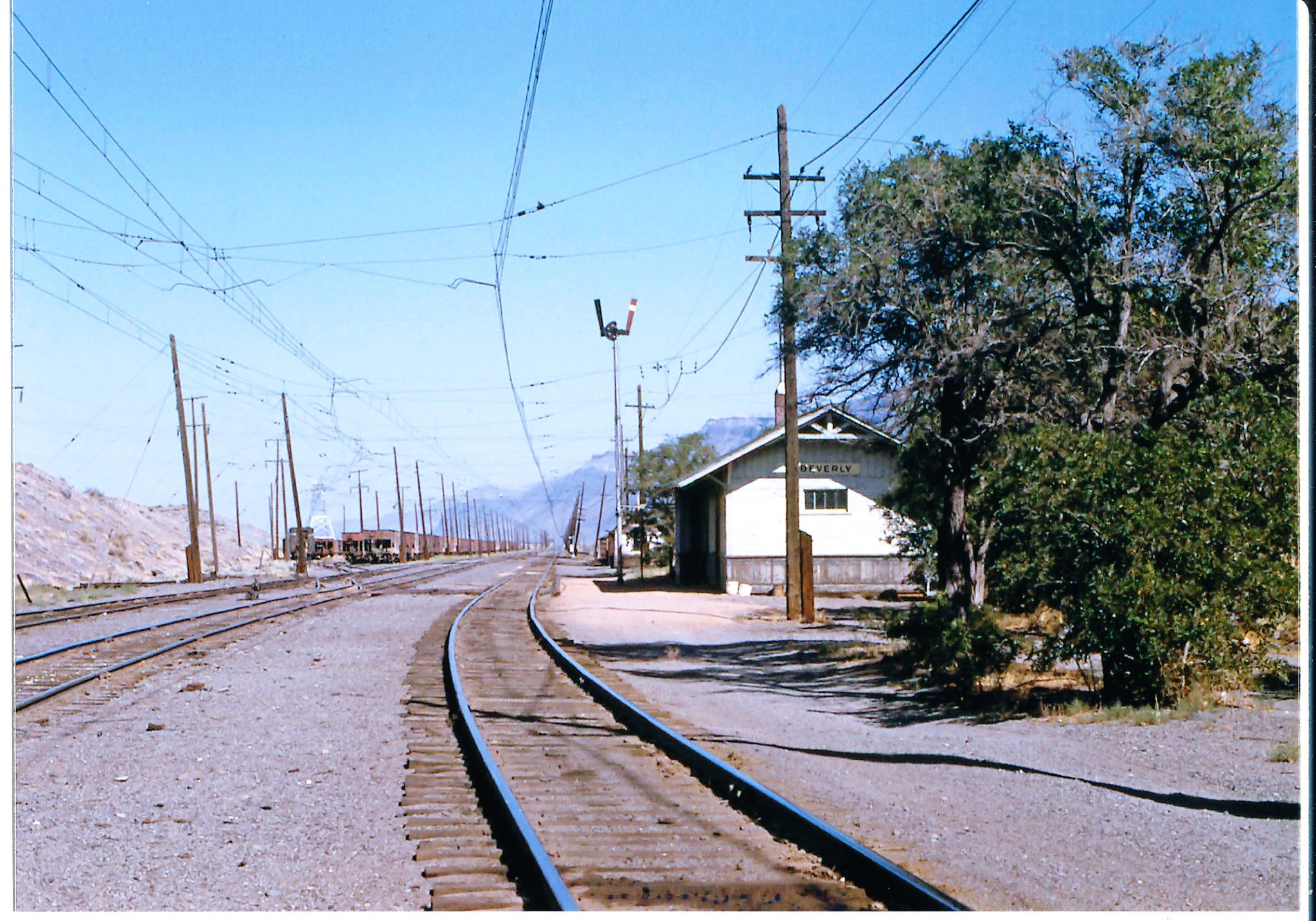
Beverly depot as it appeared when I worked there, September, 1971.

A view of Beverly looking eastward,1970. Note the beet cars stored in the yard.
E-30 box cabs assigned to the Beverly Helper, 1960's.

Beverly depot showing the annex on the east end, originally built to provide working space for all of the additional employees needed during the Hanford Reservation years of World War II.

Train 263 with the E-47A box cab set, westbound through Beverly in the early 1960's. Note the Battleships stored in the yard for beet loading at Kittitas.

Beverly bridge in 1910. Note that the second locomotive is a mid-train helper and that there is a string of empty flat cars behind it with brakemen on the decks of the cars.

Eastbound freight crossing the Beverly bridge in the late 1970's. Don Lahr photo.

The brick base for the oil service tank at Beverly. About the only thing left standing to mark the location these days.

"In the colors" at Cedar Falls. This same set up was at Beverly and Kittitas that I used my buzzer system with. Blair Kooistra photo.

One of the things that caught my eye when I worked at Beverly was this very rare CM&PS crew bulletin board that would have originally served the helper crews and later, the Hanford Local. It is easy to date with "c/o Supt Moll" on the back. Alexander Henry Moll served as Columbia Division Superintendent from November 1909 until he was replaced by Ezra Clemons in December 1910. He is also mentioned in Maxwell Swan's "Wanderlust" stories from Railroad Magazine. After the railroad shut down I made a trip to Beverly and "requisitioned" the bulletin board.

The one, and only, opportunity I had to copy and hoop up a train order to an electric. And only by a fluke. I decided to sleep in the depot and had told the dispatcher I would be there if needed.

Courtesy of Blair Kooistra.
Blair says:
"Pinch me. I'm surely dreaming.
"Forty years after Milwaukee Road abandoned its mainline across the
Northern States, precious few pieces of it remain as viable
transportation routes. Twenty miles of it from Othello to Royal City
Junction in Washington state has teetered on the edge of viability for
decades; now owned by the Port of Royal Slope and operated by
ColumbiaRail as the Washington Royal Line, this mainline section and the six-mile Royal City branch is attempting another revival to secure its future.
Traffic has been sporadic, but Port officials are hopeful that this attempt will be successful.
Moving slowly eastward to Othello and interchange with Columbia Basin
Railroad, six empty fertilizer cars cross a fill on the flank of the
desolate Saddle Mountains between Smyrna and Corfu on September 30,
2020. A former MRL SD45, #331 leads this improbable train on trackage
that logically should have been removed forty years ago. In this case,
it's a good thing that logic doesn't always prevail."


Courtesy of Blair Kooistra.
October 1, 2020
Blair says:
"Very little of the Milwaukee Road's trancontinental mainline survives
intact in Washington State--nearly all of it has been preserved as a
trail from near the Idaho line to the Seattle area.
Most intriguing
to me was the segment from Othello to Royal City Junction and the branch
to Royal City, a total of 26 miles, which was sold by the State of
Washington to the Port of Royal Slope in 2015. The Port has moved to
upgrade trackage, clear and repair slides and washouts, and contracted
Paul Dideius' ColumbiaRail to operate the line. Still, train movements
have been very sporadic.
What would be the chances I'd actually see train move on this most tenuous--and tenacious--survivor of the mainline?
"I called the Port's phone number last week listed on their website, and
talked to Port Director Bonnie Valentine. She was fascinated by my
story about photographing the branch in 1978--even then operations were
only around once a week, often at dark, and seldom photographed.
Milwaukee Road was only moving around 300 cars a year. . .only a
fraction of what the railroad thought the branch would generate when it
spent $1 millon in the early 1960s on a developing area of the Columbia
basin.
Bonnie said there were in fact six empties released from the
shipper awaiting a crew to take them away. When that would happen was
anyone's guess. Bonnie said she'd call me if she got and update on when
the train would move. That was on Thursday. Several days later, Bonnie
said there was no news.
It seemed like one of those "bucket list"
train movements I knew I didn't have much chance of photographing wasn't
going to happen during my week in Eastern Washington.
Wednesday
morning, Steven J. Brown and I got up early in Spokane and drove to
Valley, to photograph BNSF's Chewelah Turn coming south. The plan was
follow that train for a while and then head north to spend the rest of
the day on the Pend Orelle Valley.
"I was set up for a shot of the
Chewelah Turn at Jump off Joe Road above Springdale, on the climb to
Loon Lake. With the train approaching, I got a phone call at 0820 from
Bonnie: the outbound train crew would be at Royal City at 10am if you
wanted to photograph the train. Would I??? But it didn't seem like it
would be possible--from where we were, we'd have to travel 167 miles in
2'48" according to Google Maps. Surely, that train would be long gone by
the time I got there. . .but then I thought: the crew would have to
fire up the power, run the power around the train, inspect the cars. .
.railroading being railroading I figured if I drove REALLY FAST, I had a
30% chance of seeing the train on the branch. I called Bonnie back and
said I'd be there--but if the train, parked outside her office window,
moved, please give me a call.
"I was impressed how fast my rental
Grand Cherokee could move; I don't want to know how poor my mileage
would be with lots of miles at over 90 per on the two-lane
mostly-straight back roads down to the Interstate at Sprague. I pushed
it a bit on I-90 as well. . . . getting stopped by a state trooper for
being "a bit" over the limit. My pleasant attitude and cooperative
demeanor got me a warning to keep my speed down.
"I did that 167 mile
trip in 2'15", shaving a half hour off the Google estimated time. Alas,
the train had departed Royal City. .. .but dropping down the coulee a
mile south of town, there it was!! Stopping for some unknown reason. I
was in business, and a bucket list item was ticked off.
Bonnie and a
coworker, it turns out, were chasing the train as well, and I met port
commissioner Skeeter Mianecki as well, out with his camera. Apparently,
train movements are still rare enough out of Royal City that much of the
Port staff took some time off to chase it for photos.
Of course, I
chased it to Othello. It didn't move much slower than the mainline
trains did in the final months of operation--around 90 minutes for the
20 miles from the Junction to Othello, where the SD45 #331 dropped its
train and returned to Royal City.
"I shot the train in 8 locations,
aided greatly by drone technology--those locations as a 20 year old I
could run 900 feet across a field and climb 200' up ahill side to get
the shot was done with a flying camera. Even so, I was able to shoot
this train at several places I'd photographed Milwaukee Road trains at
40 years ago.
"I was pinching myself hours later at what I'd seen. I never expected to see that again!
"Here are a couple drone images from today's chase."