Monday, November 14, 2022

Jerry Gibbons Personal Story of Ephrata

Guest post by Jerry Gibbons.


I am an Ephrata native, as were my parents, Everett and Loretta (Gover) Gibbons. Both grandparents were early Ephrata pioneers, one grandfather homesteading a wheat ranch still in production on Sagebrush flats (Great Northern section) and the other apple orchards on the north end of Ephrata. 

I was born in Feb. 1931. The Ephrata depot, the trains picking up water, loading the stock cars with sheep, grain elevators etc. were all important and exciting events for kids. Mr. Pittenger was the agent, a wonderful man, who would hook up an extra telegraph key for us to practice on, let us help load the baggage cart, even occasionally hold the long wand with the string and message attached for the caboose - never the engine. 

Anyway, the "Dinky" was the train that ran from Seattle to Spokane - Spokane to Seattle every day. The morning train from Spokane came through  after 11AM and the Seattle train after 3PM. I had the Wenatchee World route in Ephrata during the war years and my papers came on the afternoon train. I could take the morning train to Wenatchee, pick up something at Sears (like my 2nd shotgun, ski boots etc.) or a new paper bag and catch the afternoon train back and then deliver my route. 

When I was smaller, my Mom would put me on the train, entrust me to the Black conductor who they all knew, to make sure I got off in Leavenworth where my Aunt and Uncle lived. I was talking to one of our Museum folks some time ago, who is also a train buff, and recalling this and he wondered if I could write an article about those events and the importance of that train. I sent off a request to a Great Northern history site I Googled some time ago and never had a response. 

I attended the 100th Anniversary celebration of Grant County a couple of years ago - my Grandfather Gover's packing shed was featured on one of the postcards. In re-reading the History editions put out by the CB Herald I noticed your name and blog. I wondered if you could direct me to any information about the "Dinky", the years it ran and even maybe the names of some of the personnel - like that conductor. I know you have written a number of articles about the history of railroads in Grant County but am not sure how to do a search. I do though want to explore your site, and know I will enjoy doing that. Thank you in advance for your information.


Gerald (Jerry) Gibbons

EHS Class of 1949


Ps: I returned to Wenatchee in 1963 and had a wonderful career as a surgeon at the Wenatchee Valley Clinic.


Sunday, November 13, 2022

Jane Summers Milwaukee Road Work History

Jane and I corresponded for a time back in 2012. She told me her work history via email. 

I remember the name (Monte Holm)but didn't have anything to do with his stream engine. Except, did he get to use the Mosey line between there and Othello once in awhile? That sounds familiar. I think it was once a year he got to use the line and it was a big deal. Am I remembering that right?

I got hired on at Othello and did my break-in there then never saw it again. Worked extra board All over the East side and into Idaho until I the Chief Dispatcher, Wayne Smith called me to come to the Coast Divn. as there was no way I could hold a station on the East side - no one retiring there., He said I could get my date on the Caost the next morning and so I went over and did that. Then worked until I was senior to all the sons of RR'rs who didn't join the union. My date was 7:59 a.m., then there were a rash of others at 8:00, 8:01, etc. but way too late they were.

My grandfather was a RR policeman for the UP and was beaten, shot and stabbed. His info is on the "Fallen Hero's site" on the internet. My mother was 13 when he was killed. I'll tell you the story sometime.

We moved to Othello in 1957 after the bacon siphon was put in and drew first one and then two farms. The first one grew rocks so we turned it back and drew again. We were farmers already from the Key Peninsula near Belfair where we farmed with a team and 1 draft horses.

We "pioneer" farmed like so many who came to make irrigated farms from dry-land. Many didn't make it. We did with lots of help back and forth from and to neighbors. We were the lucky ones. Only two kids and then only one after four years. It was hard work. We didn't have indoor plumbing until I was a sophomore because we didn't get our well until then. We hauled water from the Milw water tank to our place where we had a cistern to bring cold water into the house.

We lived the first winter in a pre-fabricated by my folks cabin which they set up the weekend before we moved there. We left paved road south of Othello, then left gravel, then dirt, then road entirely. Our place was in block 45 off of what is now the Bench road if I remember right. It was Mobray and Shive when we moved thre. After the first year, we built our daylight basement, then the upper house the next year. We had a new Monarch wood stove with hot water heater on the side and warmer above where we had yeasts, sourdough, buckwheat, etc. Interesting times.

I graduated in 1966 and went to work at Boeing, then the Milwaukee as a telegrapher, station agent, train order operator. They wanted me because I could maintain the teletypes, I'm sure. I can fix anything mechanical and for more than 30 years, electronic. After the Milw went back east I made my living working first at the Irrigation district in Othello as a Data Processing Manager, then was drafted away to another company, lumber this time, then to California (Silicon Valley) to TRW microwave. Nine months there and I came back to Washington a Computer Consultant. Giggles!!! Nothing changed for me at all by being in CA except the reputation Silicon Valley gave me.

I did work every depot on the Coast and up to St. Maries to the East and Metaline Falls to the North in Idaho and NE Wash. I worked on the Peninsula and at Hoquiam once but can't remember why I was sent there now. Farthest South I remember is Centralia/Chehalis where I had to throw the "Plant" to move rail over a mile away. No one else had to do that but they didn't want me there and so that was hazing. It took me 45 minutes to throw it but I did and the agent who was laid back in his swivel chair watching said, "Well, I'll be damned. I've worked here 15 years and I haven't seen anyone throw that plant." Jerk. He didn't know I was a farm kid.

Saturday, November 12, 2022

Jackrabbit Stops The GN At Naylor

In corresponding with the late Mike Denuty back in 2012, he had passed along this story, which I just came across again.

I ran across the following in gnry net, the GN Kalispell Division history site:

1914, 02 July:

Jack Rabbit Stops A Train

Little animal's body was hurled against the air hose, setting the brakes.

How a jackrabbit stopped the crack Great Northern express train is related by H. H. Dean of Hill yard, Washington, the engineer who stood at the throttle when the incident occurred. Here is the engineer's own version of the affair:

"We were coming through Naylor when the accident occurred," declared Mr. Dean. "We were bowling along about 50 miles an hour, pulling our full complement of coaches, when I saw a Jackrabbit coming toward us full speed in the middle of the track. The animal evidently was confused by the brilliant glare from the electric headlight and made no effort to get out of the way. Just before we struck him he stopped and crouched down, and after the engine pilot passed over him the airbrakes began to work and the train came to a sudden stop, the air register showing the brakes set on the emergency.

 "The fireman and I got out to investigate, and found that the air-hose had been uncoupled between the engine and tender. There were bloodstains and pieces of' fur on the coupling, and it was evident that the body of the rabbit had been thrown against the hose with sufficient force to break the connections."

 --- Logansport Chronicle


My dad, John Denuty, said jackrabbits were a big problem in Eastern Washington in the early years, including the Big Bend Country. They grew really BIG and were a big danger for automobiles on the highway between Reardan or Davenport and Wenatchee. Some counties paid bounties for rabbits and some had rabbit drives

In Adams County, rabbits could devastate farmers' only cash crop - wheat - so drives were conducted weekly. The carcusses were shipped by train to the Salvation Army in Spokane.

Unfortunately, at the end of one of the drives in January 1922, a Paha farmer was accidently killed by shotgun fire.

By the 1990s, with an increase in irrigation and loss of habitat, jackrabbits became rare in Eastern Washingon. 


Friday, November 11, 2022

How To Demolish A House In Othello

Photos courtesy of Allen Miller. 

February 22, 1977

Allen says:

"The Milwaukee had a situation on February 22, 1977. A Milwaukee Road freight train plowed through a 20'x 52' wood frame house at the Thacker Road crossing near Othello. The mover had stopped the house on the railroad tracks at the crossing to check clearance on some overhead wires. They had a man on the tracks watching for trains but when it showed around the curve it was too late to get the house off of the crossing in time.

"Vic Mikulich, of Enumclaw, was the engineer and Butte Fennell was the head brakeman. Vic was uninjured but Butte and another brakeman received some minor injuries. The tractor broke away from the load and none of the moving crew were injured. The house was a total loss and $20,000 damage to the locomotive. I believe the lead engine was SD40-2 No. 16 and the cab was literally filled with lumber from the collision. The ironic thing was that the house's destination was just across Highway 26 from the crossing where it was hit. Probably less than 200 feet away."


Thursday, November 10, 2022

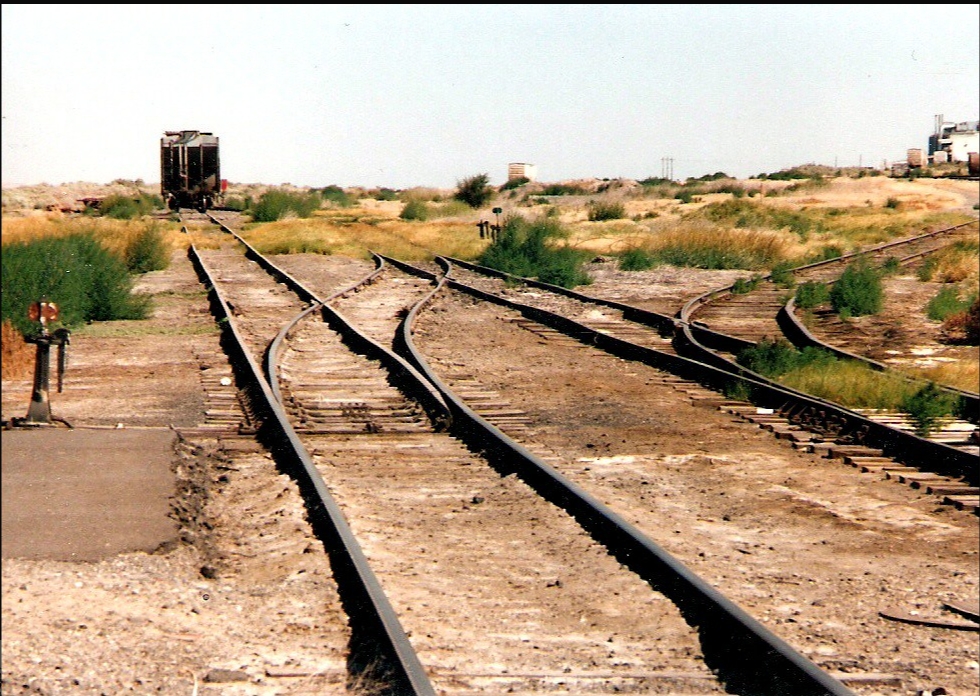
1984 Othello View

Photo by Gary Brown. 

Gary says:

"Looking RR eastward in the yard. The Coast Div. catenary ended in the distance just to the right of the covered hopper. I think this was shot around summer 1984."


Tuesday, November 8, 2022

2011 Adrian Cutoff Hike Images

Guest post by John Neff.

October 2011 timeframe

Here are some photos from my hike between Coulee City and Pinto Ridge road awhile back. I noticed that they somehow had telegraph poles and lines along there and I found one of the old insulators. I did go check out Banks lake-pretty interesting to see it that low.


Monday, November 7, 2022

The Plug That Helped Push This Website In 2010

This website was started in 2008 to chronicle railroading in the Big Bend region of Washington State. At the time, I was not certain I would be able to find very much to populate it. I should not have worried. Material is endless, seemingly, as are the connections I've made over the years. 

As I look towards the beginning of the 16th year here, the website's mission is just as tight today as it was at the beginning. I've strayed from the Big Bend region only a few times, despite how interesting something might be to me. 

I've determined to make this an interesting destination by posting daily, as I have been for years. One newer feature I've not spoken of is when I'm posting newspaper clippings, I'll post more than one on that day. I get that sometimes the clippings don't have the same eye appeal as a photo.

Anyway, back in 2010, when I was posting every other day, Micheal Sol sent a message to the Milwaukee Road group at (then) Yahoo Groups. It was heartening to read, considering his Milwaukee Road pedigree, the research he's done, the material he's seen, and the very interesting website he still maintains.

Here is the message sent:

Posted by: "Michael Sol" kimsol@xxxx.xxx

Sun Oct 31, 2010 8:47 pm 

In the "as we were speaking" department, a good example of a larger purpose happened to transpire over the weekend with regard to Milwaukee Road homesteading brochures, and related development brochures.

One of our list members, Dan Bolyard, operates what I would call a "boutique" website: modest in purpose, a very narrow focus, but therein achieving a careful and close view of the subject material, in this case railroading in the "Big Bend" area of Central Washington.

http://sdp45.blogspot.com/ (**this link still works, it's the old address for this site)

Dan has a nice search index on the right side, and so, for instance, you can quickly bring up all of his Milwaukee Road entries, and there are quite a few:

http://sdp45.blogspot.com/search/label/Milwaukee%20Road

**or you can now use: http://www.bigbendrailroadhistory.com/search/label/Milwaukee%20Road

I've long enjoyed checking in from time to time, the information Dan has on those "other" railroads has been interesting as well. It's good history and not the kind that is all that easy to find: local newspaper clippings, photos, etc. Recently Dan has had some nice photos of the Beverly bridge area -- courtesy of the digital revolution -- and a reprint of the Milwaukee Railroader article on Milwaukee's role in the Hanford Project. Of particular interest to me, Dan recently uploaded a digital reproduction of a 1911 brochure of the Beverly Investment Company.

http://sdp45.blogspot.com/2010/09/beverly-investment-company.html

**or: http://www.bigbendrailroadhistory.com/2010/09/beverly-investment-company.html

Milwaukee Road had a filing cabinet full of old promotional brochures from over the years, but, when I was there, in the early 1970s, these were pretty much one-of-a-kind things. Color photocopiers hadn't been invented yet, and the regular kind left a lot to be desired from the resolution standpoint. Most professional photography stores had a camera setup with the specialized lenses and could take actual photos of such old documents, but that was expensive, and you still were limited to the physical presence of a sheet of photography paper. And getting the physical item out of a library or other somewhat restricted area wasn't always feasible. Archival libraries did and do have such cameras, or farm the work out, and still charge very high rates for each such reproduction. And each new user gets to pay the same high fee.

Being interested in the homestead era, I have slowly been accumulating old Milwaukee settlement brochures, as they provide a vivid window into an important phase of Western settlement, what brought people West, and what visions some of the promoters had -- and often believed in themselves.

In any event, I asked Dan about that brochure, and he generously offered to provide through email the high resolution scans of the brochure that he made. And so, on the topic point, one other advantage of digitizing material is that rare materials, with a high artistic value, can not only be preserved with a high degree of authenticity, but used and shared among a far larger audience of viewers and users than the original document ever could be in this day and age.

Dan's Beverly Investment Company brochure was a new one to me. I had not seen that one anywhere before and I doubt there are many extant. It certainly expressed the high hopes of an era and, looking at Beverly today, the crushing reality.

I was glad to see the brochure, and thanks to Dan, and the digital revolution, I was able to.

Best regards, Michael Sol


Sunday, November 6, 2022

2010 Royal Slope Update Email

Back in 2010 my friend Doug Shirk of Rock Island, WA sent me this email regarding the conditions of the then dormant line from Othello to Royal City:

 Date: Fri, Aug 20, 2010 at 1:32 PM

Subject: Royal Slope Rail Line

Greetings.....


Dora and I were in Royal City this morning, and we took the

opportunity to stop at the Port of Royal Slope office and asked the

director what was going on with the rail line.  Here goes.....


In about 2008, the Columbia Basin Railroad showed some interest in

working the line....there being some interest in using it by a

decorative stone company in Royal....but dropped it like a hot rock.

Since then, the Port has been actively seeking an operator and yes,

the Eastern Washington Gateway has expressed some interest this

spring, but will not (or doesn't have the money to) rehabilitate the

track.


Over the past year, the Port commissioned a study on how much it would

cost to rehabilitate the WSDOT owned track.  They figure $1.5m would

get it in 10 mph shape, and about $9m for 40 mph operation.  They're

attempting to get the $1.5m in funding from the state.  The Port on

their own have done a little work.  One of the Port District directors

has gone over the line and cleared rock slides and other blockages,

and they'd like to go through over the next year and do weed control,

but they haven't done that yet.  All work so far has been done on a

volunteer basis.


The Port later this fall is planning to invite the local state

representatives over to give them a tour of the line, and present

their plan to reopen it, and to this end, they purchased (for $5,000)

a Fairmont speeder to give a tour of the line.


The Port figures at this point, there would be enough traffic to

support operation, but not enough to rehab it, a situation not unlike

what EWG is facing now with the PCC.  We didn't have a lot of time to

look at the study done, but it appears to be very comprehensive, and

it would be worth the time to sit down and take a look at it.


And that's the news from beautiful Royal City.  Any questions?  Ask

me.  I probably left something out.


doug shirk

Rock Island, WA